Skyroam Coupon Code - TRAVELSPIRIT

Skyroam Coupon Code - TRAVELSPIRIT
The easiest way to stay online while Traveling

Friday, July 23, 2010

Tsiftetelli

Tsifteteli is the name for Greek style Bellydance. This name comes from the Turkish word Chifteteli, which originally meant "two strings".

Tsifteteli was mainly brought to Greece by the Asia Minor Greeks, who had to leave their hometowns because of a population exchange between Greece and Turkey. Greece was occupied by the Turks for about 400 years (from the early 15th century to the early 19th century) and was part of the Ottoman Empire.

In the 1920's Greece started a war against the Turks for independence and by the mid 19th century Greece became a free and an independent state. At that time there were many people of Turkish origin and Moslem faith living in Greece as well as many people of Greek origin and Greek Orthodox faith living in Turkey.

The first Greek colonies on the west coast of Asia Minor were founded about 1000 BC and spread to the Black Sea shore. So there were Greek cities and towns in those areas until 1922 of our time. In that year there was one last big war between Greece and Turkey which ended in catastrophe for both countries. But for the Greeks the catastrophe was bigger, because many Greek cities in Asia Minor were destroyed by the Turks. The Greeks of Smyrna (Izmir) were especially hit hard. At the end of that war Greece and Turkey agreed on exchanging their remaining populations, except 100,000 Greeks in Constantinople (Istanbul) and a similar amount of Turks in North-eastern Greece and on some Greek Islands.

Nevertheless Tsifteteli as we know it today, was brought to Greece by the people of Smyrna and at first it was part of the Rembetiko culture. It developed though through the last 80 years, it spread throughout Greece and became established as the most popular and most common Greek dance together with Zeimbekia. The Tsifteteli songs today are quite different from the original Rembetiko Tsifteteli songs. The lyrics are not as sad as the ones of the Rembetiko Tsifteteli. The original Tsifteteli lyrics are very sad, because they reflect the suffering of the people that created them. They mainly talk about poverty, immigration, lost love, desperation, etc. The original Tsifteteli is not a cheerful dance, as many people outside Greece consider it to be.

Sunday, July 18, 2010

Stavros Flatley at it again lolol - Mazuma Ad in Cyprus


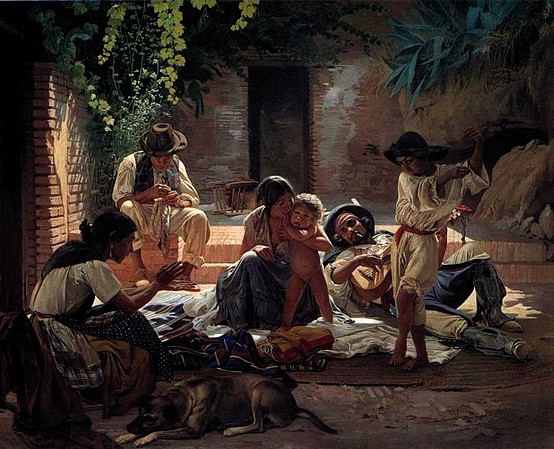
Roma Gypsy


The Romani (also Romany, Romanies, Romanis, Roma or Roms; exonym: Gypsies; Romani: Romane or Rromane, depending on the dialect) are an ethnic group living mostly in Europe, who trace their origins to medieval India.

The Romani are widely dispersed with their largest concentrated populations in Europe, especially the Roma of Central and Eastern Europe and Anatolia, followed by the Iberian Kale in Southwestern Europe and Southern France, with more recent diaspora populations in the Americas and, to a lesser extent, in other parts of the world.

Their Romani language is divided into several dialects, which add up to an estimated number of speakers larger than two million.[17] The total number of Romani people is at least twice as large (several times as large according to high estimates), and many Romani are native speakers of the language current in their country of residence, or of mixed languages combining the two. *wikipedia*


 Contemporary scholars have suggested one of the first written references to the Roma, under the term "Atsingani", (derived from the Greek atsinganoi), dates from the Byzantine era during a time of famine in the 9th century.
In the year 800 A.D., Saint Athanasia gave food to "foreigners called the Atsingani" near Thrace. Later, in 803 A.D., Theophanes the Confessor wrote that Emperor Nikephoros I had the help of the "Atsingani" to put down a riot with their "knowledge of magic"."Atsinganoi" was used to refer to itinerant fortune tellers, ventriloquists and wizards who visited the Emperor Constantine IX in the year 1054. The hagiographical text, The Life of St. George the Anchorite, mentions that the "Atsingani" were called on by Constantine to help rid his forests of the wild animals which were killing off his livestock. They are later described as sorcerers and evildoers and accused of trying to poison the Emperor's favorite hound.

Karsilamas

The term "karsilamas" comes from the Turkish word "karsilama" meaning "face to face greeting" and is often used as a slang word designating the pickpocket's method of knocking against someone to steal his wallet. The Greek name of the dance is Antikristos Makedonikos, meaning "face to face dance from Macedonia."
The dance was popular around Constantinople (now İstanbul, Turkey) during Byzantine times. Originally a warlike dance, the Turks adopted it when they conquered the area.
 

Kostas Macedonas - Gynaika

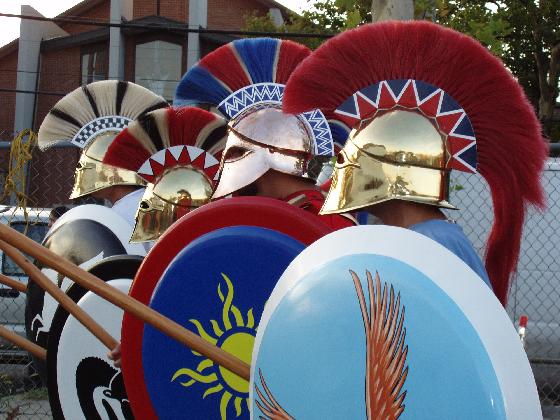
Greek Warriors

The Greek Warriors is a living history organization based in the New York City area. We represent Ancient Greek warriors in full Greek armor from head to toe. Spears, shields, and Corinthian helmets with tall horse hair crests, are all part of having a living history demonstration performed for you. See ancient Greek warriors live! We are available for the following kinds of events:

 
Film and Television
Greek Civic and Cultural Events
Greek Festivals - one of our favorite types of events
Advertisement
Conventions and Special Events

Arachne

 There was a certain maiden of Lydia, Arachne by name, renowned throughout the country for her skill as a weaver. She was as nimble with her fingers as Calypso, that nymph who kept Odysseus for seven years in her enchanted island. She was as untiring as Penelope, the hero's wife, who wove day after day while she watched for his return. Day in and day out, Arachne wove too. The very nymphs would gather about her loom, naiads from the water and dryads from the trees.
"Maiden," they would say, shaking the leaves or the foam from their hair, in wonder, "Pallas Athena must have taught you!"
But this did not please Arachne. She would not acknowledge herself a debtor, even to that goddess who protected all household arts, and by whose grace alone one had any skill in them.
"I learned not of Athena," said she. "If she can weave better, let her come and try."
The nymphs shivered at this, and an aged woman, who was looking on, turned to Arachne.
"Be more heedful of your words, my daughter," said she. "The goddess may pardon you if you ask forgiveness, but do not strive for honours with the immortals."
Arachne broke her thread, and the shuttle stopped humming.
"Keep your counsel," she said. "I fear not Athena; no, nor any one else."
As she frowned at the old woman, she was amazed to see her change suddenly into one tall, majestic, beautiful,—a maiden of grey eyes and golden hair, crowned with a golden helmet. It was Athena herself.
The bystanders shrank in fear and reverence; only Arachne was unawed and held to her foolish boast.
In silence the two began to weave, and the nymphs stole nearer, coaxed by the sound of the shuttles, that seemed to be humming with delight over the two webs,—back and forth like bees.
They gazed on the loom where the goddess stood plying her task, and they saw shapes and images come to bloom out of the wondrous colours, as sunset clouds grow to be living creatures when we watch them. And they saw that the goddess, still merciful, was spinning, as a warning for Arachne, the pictures of her own triumph over reckless gods and mortals.
In one corner of the web she made a story of her conquest over the sea-god Poseidon. For the first king of Athens had promised to dedicate the city to that god who should bestow on it the most useful gift. Poseidon gave the horse. But Athena gave the olive,—means of livelihood,—symbol of peace and prosperity, and the city was called after her name. Again she pictured a vain woman of Troy, who had been turned into a crane for disputing the palm of beauty with a goddess. Other corners of the web held similar images, and the whole shone like a rainbow.

Sunday, July 11, 2010

the thong also rises :-)


Too many travel guides are dry lists of attractions or portentous histories of a place. This isn't the case with The Thong Also Rises. Hot on the (high) heels of Sand in My Bra and Whose Panties Are These? comes this collection of the best in women’s travel and humor writing. These Ms-adventures take readers around the world and back again — and they’ll be happy to be reading rather than experiencing some of these adventures. Subjects include learning how to go to the bathroom with a pig in Thailand, trying to explain that sex toy to customs while Mother is watching, attending naked wedding ceremonies on Valentine’s Day in Jamaica, conquering that consuming fear of wooden puppets with a visit to Prague, boarding a crusty old Soviet Bomber in Laos, and more.

5 Sources for Free Greek Philosophy Education Online

Want to broaden your mind and learn more about the philosophy of the Greek language and Greek mind? Here are five fantastic courses for free Greek philosophy education online.

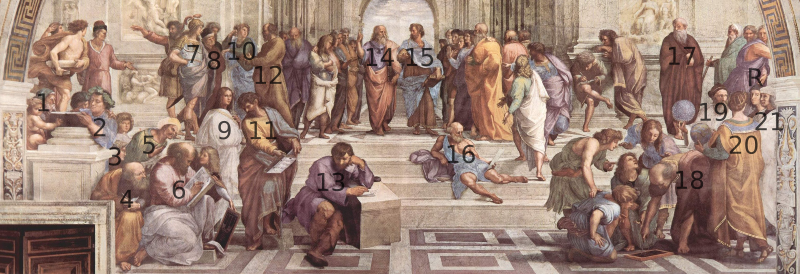
School of Athens


The identity of some of the philosophers in the picture, such as Plato
Plato , was a Classical Greek philosopher, mathematician, writer of philosophical dialogues, and founder of the Academy in Athens, the first institution of higher learning in the Western world...
 or Aristotle, is incontrovertible. But scholars disagree on many of the other figures, some of whom have double identities as ancients and as figures contemporary to Raphael. The extent of double portrayals is uncertain although, for example, that Michelangelo is portrayed (no. 13 below) is generally accepted. According to Lahanas, they are usually identified as follows :

http://www.absoluteastronomy.com/topics/The_School_of_Athens

Thursday, July 8, 2010

The Beauty of Greece

Asia Minor Greeks

The persecutions, massacres, expulsions, and death marches of the Asia Minor Greeks were renewed during the early 20th century by the Young Turk administration of the Ottoman Empire and during the subsequent revolution of Mustafa Kemal Atatürk. The Ottoman Greek population was severely affected; its misfortunes became known as the Greek Genocide. After the defeat of the Ottoman Empire during World War I, the Allies granted Greece, with the Treaty of Sèvres, the administration of Eastern Thrace (apart from Constantinople) and the city of Smyrna and its environs. The Pontic Greeks attempted to establish their own republic, the Republic of Pontus. The defeat of the Greek army during the Greco-Turkish War led to what became known in Greece as the Asia Minor Catastrophe. A series of events, with the Great Fire of Smyrna been their peak, diminished the 3,000 year old Greek presence in Asia Minor. The Treaty of Lausanne, which was signed in 1923, anticipated the compulsory exchange of populations. The remaining Greek Orthodox population of Asia Minor and Eastern Thrace, as well as the Muslim population of Greece (the Greeks of Constantinople, Imbros and Tenedos and the Muslims of Western Thrace were excluded) were denaturalized from homelands of centuries or millennia.
The Asia Minor Expedition and Catastrophe, as well as the uprooting of the ethnic Greek population from Anatolia after three thousand years of presence, had an enormous impact on the Greek psyche. The Smyrna Catastrophe has been considered as the worst incident of modern Greek history, and as an incident of the same magnitude as the Fall of Constantinople for the Greeks. The matters related to the refugees halted the Greco-Turkish relations for many decades. The issues concerning the missing Greeks were soon raised in the International Red Cross, without any success and cooperation from the Turkish side. To this day, the Greek citizens who were born in Asia Minor have to apply for a visa in order to enter Turkey (something that does not apply to Greek citizens born in Greece).
The descendants of the refugees have found hundreds of organizations and institutes in Greece and in the diaspora to promote their civilization and to keep in touch with their roots. Various museums in Greece (such as the Benaki Museum) display artifacts from Asia Minor, Pontus, Cappadocia and Eastern Thrace to denote the Greek presence and emphasize the origins of about 40% of the population of modern Greece. *Wikipedia*


This is a list of refugee settlements in Greece (the place of origin is in parenthesis)


Orestiada, Evros (Adrianople)
Drama*, (Pontus and Asia Minor)
Kavala*, (Pontus and Asia Minor)
Xanthi*, (Pontus and Asia Minor)
Pontoiraklia (Serres), (Heraclea Pontica, Pontus)
Nea Karvali, Kavala (Cappadocia)
Nea Moudania, Chalcidice (Apamea Myrlea)
Nea Triglia, Chalcidice (Triglia)
Nea Santa, Kilkis (Pontus)
Loutrochori, Pella (Pontus)
Kalamaria, Thessaloniki (Pontus)
Menemeni, Thessaloniki (Mainemeni)
Nea Madytos, Thessaloniki (Madytus, Gallipoli)
Nea Michaniona, Thessaloniki (Pontus)
Nea Magnesia, Thessaloniki (Manisa)
Nea Filadelfeia, Thessaloniki (Philadelphia)
Nea Krini, Thessaloniki (Krini)
Toumba, Thessaloniki (Pontus and Asia Minor)
Saranta Ekklisies, Thessaloniki (Saranta Ekklisies)
Eleftherio-Kordelio, Thessaloniki (Kordelio)
Chalkidona, Thessaloniki (Chalcedon)
Nea Kerasous, Preveza (Kerasous)
Nea Sampsous, Preveza (Sampsous)

Nea Sinopi, Preveza (Sinopi)
Anatoli, Ioannina (Asia Minor)
Nea Ionia, Magnesia (Ionia)
Mandra, Larissa (Misthi, Cappadocia)
Amygdalea, Larissa (Cappadocia)
Nea Sinasos, Euboea (Sinassos)
Nea Artaki, Euboea (Artaki)
Nea Kios, Argolis (Cius)
Patra*, Achaia
Nea Alikarnassos, Heraklion (Halicarnassus)
Kallithea (Pontus)
Argyroupolis (Pontus)
Drapetsona (Pontus)
Sourmena (Pontus)
Nea Chalkidona (Chalcedon)
Nea Erythraia (Krini)
Nea Filadelfeia (Philadelphia)
Nea Smyrni (Smyrna)
Kesariani (Ionia)
Nea Fokaia (Phocaea)
Nikaia (Asia Minor), (Pontus)
Keratsini (Asia Minor)
Nea Ionia (Pisidia, Cilicia, Isparta, Cappadocia)
Paleo Faliro (Constantinople)
Nea Makri (Makri, Fethiye)
Saframpolis, Nea Ionia (Safranbolu)
Inepolis, Nea Ionia (Inebolu)


Tuesday, July 6, 2010

Scorpio is perhaps the most complex and misunderstood zodiac sign

Scorpio is perhaps the most complex and misunderstood zodiac sign. Single minded, and driven by intensity of purpose. Scorpios approach life with total commitment, or none at all. This deep, secretive, and impenetrable sign has a strong impulse to immerse itself in life and this is no more evident than in close relationships.

Often intensely lonely and with a voracious need to connect deeply with others, Scorpios have an overwhelming desire to feel a strong emotional bond with anything, or anyone, in which they are invested. The Scorpio individual is on the path towards learning how to integrate their own darkness. No matter how controlled Scorpio appears on the surface, they are characterized by passionate emotional convictions. The underlying principle of Scorpio is transformation, and this doesn’t come easy. It involves the release of the ego and this usually triggers pain and traumatic emotions. Being the second water sign on the zodiac wheel, Scorpio reaches a point of emotional crisis. Scorpio’s have profound emotions and in order to hide their vulnerability, they sting and wound anyone who seems to threaten them. Scorpio operates between passionate engagement with the object of their desire to frozen withdrawal it all depends on how vulnerable Scorpio is feeling at the time. The Scorpion realizes that while intimacy can heal it can hurt as well.

Monkeydonia

Monkeydonian is a person who holds the view that by renaming a potato to apple, the potato will then taste like an apple. In other words, it is the person who thinks that by renaming a country's name from 'Vardaska' to 'Macedonia', in the mid 20th century, he can include in its identity, all Macedonian history that took place even as far as 2000 years before the name change. This is really a script for Aristofanes.. -Monkeydonian is someone, who when it comes to history and historical perspective, he can not count up to three, but at the same time will make arguments witch he will firmly support, even if all evidence would point, or even shout, against him. -Monkeydonians are all those who have been in school after 1991 in FYROM, and have fallen victim of revisionist education, Gruevskis cabinet agenda, and other nationalist propaganda. -Finally and most importantly, Monkeydonians are those who are actively involved in any sort of deliberate, organized, intentional attempt towards world history falsification, so as to achieve their own goals and interests. -Being Monkeydonian does not include all those FYROM citizens that agree with the above, have a sense of historical perspective, take pride in their real past, and are thus more honest and true to their ancestors and their history. -Also excluded are the all innocent children that have fallen victim of their educational system, and who I personally sympathize with the most. -One can not blame one, for what he does not know! So lets start from education. So lets start from education.

In Search of an Honest Man

In Search of an Honest Man

BY ADRIAN VRETTOS
ONE of my all-time heroes is Diogenes the Cynic, who spent most of his life chilling in his barrel outside the city-state of Corinth . He was the original Cynic because he believed that men and women lived a life dictated by rules and taboos and therefore no one was really truthful or honest. Actually Diogenes is my hero because he was witty, rude, and had little respect for authority. For example, when Alexander the Great rode down to visit Diogenes in his barrel, he offered Diogenes any gift of his choice. With a scowl, Diogenes snapped back his response: "What you've taken away, you can never give me."
 
"Huh?" said Alex.
 
"You're standing in my sun."
 
What most people know about Diogenes is that he wandered around ancient Greece carrying a lantern and searching for an honest man. In Plaka you can find the figures of him and his lantern and Rataplan, his mangy mutt. What most people don't know is why he went searching for an honest man when he believed, as a Cynic, that there was no such person.


Sunday, July 4, 2010

Greek Shows on the Internet


http://www.livemovies.gr/series/karma

Evros

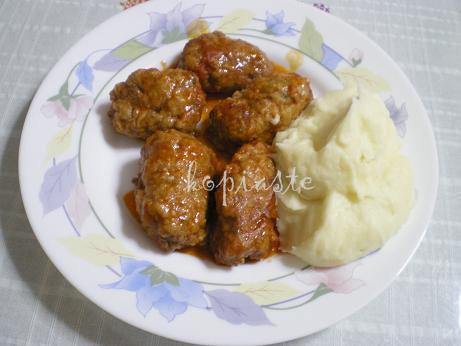
Smyrneika-meatballs-in-tomato-sauce - Kopiaste

The word soutzoukakia derives from the Turkish soujouk, which is a dry, spicy, sausage and the Greek suffix -akia, meaning «small». The fact that it derives from the Turkish word does not mean, of course, that this is Turkish, as in Wikipedia we often see various things named as Turkish, when in fact they are not. Smyrneika describes the origin, which is Smyrna.
Smyrna was situated on the eastern shores of the Aegean Sea, opposite Chios in Asia Minor, with mainly Greek population.
In the early 20th century; Smyrna used to be a large, rich and cosmopolitan Greek community, who were renowned for their trading achievements, mainly dealing in tobacco and was famous for its cuisine.
After the invasion of the Turkish army into Smyrna in 1922 and the burning of the city by the Turks, the entire Greek population was ejected from Smyrna and forced to seek refuge, originally to Greece and then to other countries.
Most of the refugees came to Greece; some went to Cyprus and some all over the world. It is estimated that only in Greece more than a million refugees came and settled here. We can recognize places where the refugees settled, by the names they gave to these places, where respective cities there in Asia Minor had the same name i.e. Smyrni became Nea Smyrni, (Nea meaning new) Nea Ionia, Nea Makri, Nea Philadelphia, Nea Chalkidona, Nea Erythrea, Nea Mychaniona, Nea Kallikrateia, Nea Malgara and innumerable other places.

Smyrneika

SMYRNEIKA was the Greek cabaret tradition from Smyrna (Izmir), songs born in the Anatolian tavern, or cafe-aman. Intricate melodies and popular sing-along refrains (often reflecting the musical influence of Smyrna's Turkish, Armenian, and Jewish populations), were set to sensual dance rhythms (tsiftetelli, karsilama), and played on the santouri, outi, violi, clarino, doumbeleki, and zilia. The colorful lyrics centered around love (usually unrequited but hopeful), nostalgia (for the lost homeland), and the celebration of life through music and dance. These songs required a combination of superb vocal skills and a flair for entertaining on the part of singers - Antonis Dalgas, Roza Eskenazi, Rita Abadzi, Marika Kanaropoulou, and others - whose virtuosity and artistry still shine through the hiss of surviving 78s. * Kefi is an ebullient mood, an intense state of mind, considered essential for making music.The irrepressible kefi of the Asia Minor refugees resulted in a rich musical legacy, a testament to the indestructible Greek spirit. As Roza Eskinazi wrote: "We sang for the world. Our songs had a genuine, true feeling, full of joy, verve, and artistry."

Rebetika Music


In 1921 the Greek army occupied Turkey at the instigation of England, France, Italy and Russia. The Ottoman empire was in a state of collapse and the Great Powers, eager to carve up the territory, let Greece know that if they were to take the coast of Asia Minor where there were two million Greeks living there from ancient times, they could expect support. (They were using Greece to do their dirty work for them since the Italians had invaded from the south and were marching North. They wanted to use the Greeks to stop them from taking the entire coast of Asia Minor.) All went well and the Greek army controlled Smyrna and the coast but then two things happened that sent events rapidly downhill. The Greek army decided to march inland and take Ankara while at the same time the French backed out of the deal. This caused the other powers to withdraw their support so as not to start another world war. The Greek army found itself in retreat from a Turkish army led by Kemal Attaturk. As they passed through towns and cities they were joined by the local Greek population who did not want to be left behind when the angry Turks swarmed into town. Thousands died and the city of Smyrna was burned.

As the army retreated back to Greece it brought with them the surviving Greek population of Asia Minor. By 1922 there were two million refugees in the country. These were Greeks who had never lived in Greece. They had come from the fertile lands of Anatolia but were now forced to live in a small mountainous country that could not support them, or in refugee settlements in Pireaus and Thessaloniki. It was in the cafes and hash dens near these settlements that what we know as Rembetika was forged from the early mainland movement with its bouzouki and the oriental tunes, rhythms and singing techniques that came from Asia Minor.  
Imagine yourself as a refugee. In Asia Minor you may have had a business, a nice home, money, friends, family. But in the slums of Athens all you had was whatever you could carry with you out of Turkey, and your shattered dreams. You went from being in the middle class to being underground in a foreign country that did not particularly want you. Rembetika was the music of these outcasts. The lyrics reflected their surroundings, poverty, pain, drug addiction, police oppression, prison, unrequited love, betrayal and hashish. It was the Greek urban blues. 
 

Greek Horoscopes - Pathfinder.gr


Κάποια γεγονότα θα επηρεάσουν τη ψυχολογία σας, καλό θα ήταν να προσέξετε τις κινήσεις σας *Μιλήστε σε πρόσωπα που εμπιστεύεστε καλύτερα *Δοκιμάστε να ξεκινήσετε καινούργια πράγματα, τα άστρα είναι ευνοϊκά μαζί σας και σας βοηθούν να ξεφύγετε από τα προβλήματα του παρελθόντος

Επαγγελματικά

Στην εργασία σας καλό θα ήταν να προσέξετε τις κινήσεις, φροντίστε να μην κάνετε κινήσεις που θα δημιουργήσουν εντάσεις με τους συνεργάτες σας *Φροντίστε στα οικονομικά σας να δείξετε προσοχή, μην κάνετε κινήσεις οι οποίες θα σας πιέσουν και θα βγάλουν εκτός προγραμματισμού

Αισθήματα

Με την ερωτική σας διάθεση σε ανεβασμένα επίπεδα θα έχετε την ευκαιρία να περάσετε μοναδικές στιγμές πάθους με το έτερον σας ήμισυ φίλοι μου *Αποφύγετε να κάνετε κινήσεις οι οποίες μπορεί να παρεξηγηθούν από τρίτους, κρατήστε μια απόσταση και πάρτε λίγο χρόνο φίλοι αδέσμευτοι

Υγεία

Προτιμήστε να μην μείνετε σπίτι σήμερα, συναντήσεις με φιλικά σας πρόσωπα θα σας χαλαρώσουν και θα σας ηρεμήσουν πολύ μετά την εργασία σας *Φροντίστε λίγο καλύτερα τη διατροφή σας αποφεύγοντας τις τροφές που έχουν πολλά λιπαρά, εμπλουτίστε τη με φρούτα και λαχανικά