Skyroam Coupon Code - TRAVELSPIRIT

Skyroam Coupon Code - TRAVELSPIRIT
The easiest way to stay online while Traveling

Saturday, April 30, 2011

Canadian Election and Astrology - Please Vote and make a difference

CANADA’S FEDERAL ELECTION: 
The new moon on Canada’s Federal Election day occurs after the polls close. Technically, the election happens during the dark of the moon, or the balsamic cycle, which is an especially potent time of seeding for the extended future. This Canadian election is already a history making one due to the fact that the government (commonly referred to as Harper’s regime) collapsed on charges of contempt of parliament. I predict it will be history making in another regard and that is because there will be a record number of young voters (the Pluto in Scorpio generation).
We can expect a tough fight to the finish. Both Conservative leader Stephen Harper, our current Prime Minister, and Liberal leader Michael Ignatieff, the current leading opposition party, are Taurus born. This is a tenacious sign, and as we have seen, especially with Harper, it can be a stubborn one too. Both men also share their moon positions in cool and collected Aquarius, an apt placement for political and public life. Of the two moons, Ignatieff expresses his moon through an intellectual filter, while Harper expresses his moon with a detached presence. Many would say that Harper is out of touch with the people’s needs and wants. Although the moon in Aquarius is group, community, and people oriented, it is not a warm and fuzzy moon placement, which is one of the reasons that Cancer born Jack Layton has found such opportunity in grooming public favour. Layton’s ascendant, Mars and Neptune in Libra make him personable and accessible – and most would say he’s handsome too. (You can’t ignore the fact that physical appearance counts too.)
The new moon in Taurus, May 2, 11:51 pm PDT, favors Harper’s sun, suggesting his supporters will stay loyal. It also suggests that as he is promises to do, that he will deliver more of the same. If Harper’s steering is not to your liking, check out this website:http://www.projectdemocracy.ca/)
Ignatieff’s chart receives impact from the Aries line-up. The enraged with “as is” are in his camp.  Still there are a number of challenges to his chart. The transit of Jupiter could signal a big exodus of voters, I truly hope not, especially if it results in Harper’s gain. The transit of Jupiter conjoins his Sedna – will he be thrown overboard in keeping with this Inuit mythological symbol? It is looking possible right now. Ignatieff’s progressed Jupiter at station has not allowed him to be as dynamic in the public debates as he needed to be. Into the fall and beyond, we’ll see a more forceful and recalibrated leadership as Ignatieff’s Jupiter picks up a stronger momentum. Signalling a new trajectory, he begins a new Mars cycle on election day. Perhaps this election has been astrologically premature for Ignatieff. His potential is building, but his chart has not yet reached its fullness.
Cancer born Jack Layton’s sudden popularity rise is due to Uranus, Venus, Mercury, the karmic axis, Chiron, and the July 1st solar eclipse. With Eris on his side, he plays the golden apple position. He is the wild card draw and it seems he is on the way to delivering a strong finish. The young voters are in his camp. Layton’s moon is in Virgo, a service oriented and hard working sign. He and Ignatieff are of the Pluto in Leo generation, a good placement for a leader. Although Layton can display charming “favourite uncle” humbleness, Mercury in Leo gives him bravado too. Be rest assured, he is just as ambitious and self-assured as the rest are. By the way, Harper is of the Pluto in Virgo generation. Criticism comes his way a lot – and rightly so. How can you choose women’s health as your global initiative and not include reproductive health???
Given the nature of the stars, anything could happen, but one thing is for sure.Apathy is boring. Please get out and vote on May 2. And a special plea to our Pluto in Scorpio generation – you have the power to turn the tides. Our nation pins its hope on you.

Monday, April 25, 2011

Tsetstos - Thrace

Tsestos is a challenging dance from Northern Greece(the region named Thrace or in greek language Thraki). The dance starts with a moderate rhythm and is danced by both men and women with very few figure(this is an intro dance named Dousko,the steps are the same whit the dance Zonaradiko . As it goes on men come in front and they catch each other by the zonari (belt). At this point the dance becomes very quick and it consists of figures only.


http://wn.com/Tsestos-Traditional_Greek_Dance

Sunday, April 24, 2011

Greek Hip Hop aka Pentozali


The Pentozali or Pentozalis is the trademark folk dance of the island of Crete. It takes its name from its five ("pente") basic steps and its sprightly and ultimately very fast pace ("zalos" being a rare Greek word for "jump"). The name can thus be translated as "five-jumps", its typically Greek wordplay implying that dancing it can make one jump five times over. Also in the spirit of wordplay, "zali" means dizziness, and the name of the dance can also be understood ("five-dizzy") as one that can make the dancers dizzy five times over.
The Pentozali is a war dance, vigorous, with high jumping movements and allows for much improvisation. It starts at a moderate pace and accelerates progressively. The dancers hold each other by the shoulders and form an incomplete circle, which rotates counterclockwise very slowly, or sometimes not at all, because most of the lively steps are semistationary. The first dancer is expected to improvise engaging in acrobatics; in this case he and the second dancer hold hands, rather than shoulders, and the second dancer stands still and rigid, so that the first dancer has a stable base on which to perform. Once the first dancer has finished his part, he is expected to break ranks and slowly dance his way to the back of the line, yielding his place to the second, and so on. Women also perform the dance, but their steps are more restrained because their dress does not allow for high jumps. Traditional Cretan menswear, on the other hand, facilitates acrobatic dancing as it includes the black vraka, a variant of breeches that are worn tight around the waist and thighs and extremely baggy and loose around the hips.
Pentozali music is instrumental: the main tune is played by the pear-shaped, bowed Cretan lyre, to the accompaniment of a lute, played not in a melodic but in a percussive-like fashion. It is the lyre player who usually directs the flow of the dance: he improvises to signal the first dancer to improvise too, and resumes the main tune when it is time for the first dancer to yield his place to another.
It has often been suggested that this may be the descendant of a Minoan dance, perhaps that of the Kouretes, a mythical troupe of ancient warriors. There is a forgotten dance of the area of the Psiloritis Mountains where the Kouretes lived, called Empyrrikios (from the ancientPyrrichios), whose steps are very similar to Pentozali.
Wikipedia

Friday, April 22, 2011

Jesus Of Nazerath

A movie filmed in 1977 that depicts the life of Jesus Christ using the Gospel accounts. This is probably one of the best movies ever made about Yah'shua (Jesus). The movie is true to the Gospels with virtually no change from what the Bible says.

This movie is very difficult to find and it is 6:16 hours long. Rarely during the movie do any of the actors portraying Jesus blink their eyes. Director 'Franco Zeffirelli' decided on this as a means of creating a subconscious visual mystique about the character that not only differentiated him from all other characters, but is eerily effective.


http://youtu.be/_rG5wcgWsHE - FULL MOVIE


For better (e.g., St. Francis of Assisi, Mother Teresa) and, unfortunately, for worse (the crusades, the Inquisition), the past two millenia of Western Civilization have been predominantly Christocentric. Jesus of Nazaretth has inspired countless artists, sculptors, architects, composers, theologians, and writers, and over the last 2,000 years more cultural artifacts are devoted to the story of his life than that of any other individual.
The exact date for the birth of Jesus of Nazareth is uncertain, but we know it could not have been after 4 B.C. (Some scholars date his birth as early as 7 B.C.) He grew from boy to man in Nazareth in Galilee, though the New Testatement tells us almost nothing of his youth. His career and teaching are recorded in the Gospels, the first four books of the New Testament. Drawn to the preaching of John the Baptist, Jesus was baptized by John in the Jordan river and began his three-year public ministry.
He became an itinerant rabbi (teacher), gathering a small company of associates (disciples or Apostles) and a larger company of followers, and travelled in Galilee, Tyre, Sidon and finally to Jerusalem over a period of about three years. There he was arrested and brought to trial in the administration of the Roman procurator Pontius Pilate, probably in the year 29 A.D (or possibly 33 A.D.). He was condemned to die by crucifixion. Upon his death, his followers left for their homes, but quickly regathered in Jerusalem, being convinced that Jesus was raised from the dead, or resurrected.
http://www.culturalresources.com/Jesus.html
http://www.morethings.com/god_and_country/jesus/jesus_photo_gallery22.htm


Happy Easter - Kalo Paskha


Easter (Old English: Ēostre; Greek: Πάσχα, Paskha; Aramaic and Hebrew: פֶּסחא‎ Pasḥa,) is the central feast in the Christian liturgical year.[1] According to the Canonical gospels,Jesus rose from the dead on the third day after his crucifixion. His resurrection is celebrated on Easter Day or Easter Sunday[2] (also Resurrection Day or Resurrection Sunday). The chronology of his death and resurrection is variously interpreted to be between AD 26 and 36, traditionally 33.
Easter marks the end of Lent, a forty-day period of fasting, prayer, and penance. The last week of the Lent is called Holy Week, and it contains Good Friday, commemorating thecrucifixion and death of Jesus. Easter is followed by fifty-day period called Eastertide or the Easter Season, ending with Pentecost Sunday.
Easter is a moveable feast, meaning it is not fixed in relation to the civil calendar. It occurs during the spring, in March or April; the method for determining the date of Easter Sunday is complex, based on lunisolar calendar.
Easter is linked to the Jewish Passover by much of its symbolism, as well as by its position in the calendar. In many European languages, the words for "Easter" and "Passover" are etymologically related or homonymous.[3] The term "Pascha", from the same root, is also used in English to refer to Easter.
Easter customs vary across the Christian world, but decorating Easter eggs is a common motif. In the Western world, customs such as egg hunting and Easter Bunny extend from the domain of church, and often have a secular character.


Easter in Leonidio

A unique and spectacular Easter custom has been revived in the small town of Leonidio in Arcadia Prefecture, southern Greece.
At the stroke of midnight on Easter Sunday, the sky will be lit up by hundreds of multicolored hot air balloons that will offer a captivating spectacle as they rise into the horizon for 30-40 minutes before burning out or disappearing over the sea or the nearby forest.
They are handmade by the local people and the town's five parishes compete with each other to keep up in the air as many balloons as possible for the longest period of time.


The streets of Greece and Greek Orthodox communities throughout the world ring with happy voices sharing Chroniá Pollá! - Easter Wishes...


Easter time, from the carnivals that come before the Lenten fast through Holy Week and the celebrations of Easter, is a special season in Greece.
Greek Orthodox Easter 2011
Since the date of the Greek Orthodox Easter is based on a modified Julian calendar and the Western world uses the Gregorian calendar, the festivities sometimes do not usually occur at the same time as other Christian Easter celebrations.
Sometimes the two dating systems happily collide, however. In 2011 Greek Orthodox Easter is celebrated on the same day as Easter in the Western church this year — on Sunday, April 24 — although marked by unique traditions that make Easter in Greece different than Easter celebrations in other lands.
http://www.chiff.com/a/easter-greece.htm
http://www.holidaycorfu.org/greek_easter/
http://www.flickr.com/photos/orttodox/galleries/72157624112535297
http://youtu.be/LEFOfcw0hzY

Thursday, April 21, 2011

Jean Simmons -Never be afraid to fail. Every time you get up in the morning, you are ahead.

It may be simplistic, but you could sum up my two marriages by saying that, when I wanted to be a wife, Jimmy [Stewart Granger] would say: 'I just want you to be pretty.' And when I wanted to cook, Richard would say: 'Forget the cooking. You've been trained to act – so act!' Most people thought I was helpless – a clinger and a butterfly – during my first marriage. It was Richard Brooks who saw what was wrong and tried to make me stand on my own two feet. I'd whine: 'I'm afraid.' And he'd say: 'Never be afraid to fail. Every time you get up in the morning, you are ahead.'


Her Hollywood career was more prolific than distinguished. She possessed the cool English reserve that intrigues many Americans. With few outward signs of inward passion, she represented a mystery and a challenge. Many English actresses, from Deborah Kerr to Julie Andrews, have enjoyed long and profitable careers by exploiting that very uncertainty. These actresses were so genteel that Hollywood felt instinctively that they must be treated as queens or virgins. For her part, Jean Simmons certainly was — several times. She played the future Virgin Queen in Young Bess (1953) and a Salvation Army lass in Guys and Dolls (1955).
And yet, underlying these whiter-than-white roles, there were sneaking suspicions. Could she really be so spotless? Might not there be skeletons lurking in the Simmons cupboard? In her private life, there was plenty to raise late-1940s eyebrows. Stewart Granger, who was to become her first husband, was still married to Elspeth March when they first associated off-screen.
For many years, Hollywood was unsure how to cast her. Should it play to her traditional image as a patrician? It did so in such films as The Robe (1953) and Désirée (1954), as a high-born aristocrat opposite Marlon Brando’s Napoleon. Or should it hint at hidden depths? Angel Face (1953) and The Many Loves of Hilda Crane (1956) leant in that direction.

http://www.telegraph.co.uk/news/obituaries/culture-obituaries/film-obituaries/7061131/Jean-Simmons.html

Spartacus "a Thracian of Nomadic stock"

Spartacus (Greek: Σπάρτακος, Spártakos; Latin: Spartacus[1]) (c. 109 BC – 71 BC) was the most notable leader of the slaves in the Third Servile War, a major slave uprising against the Roman Republic. Little is known about Spartacus beyond the events of the war, and surviving historical accounts are sometimes contradictory and may not always be reliable. He was an accomplished military leader.

Spartacus' struggle, often seen as oppressed people fighting for their freedom against a slave-owning aristocracy, has found new meaning for modern writers since the 19th century. The rebellion of Spartacus has proven inspirational to many modern literary and political writers, making Spartacus a folk hero among cultures both ancient and modern.

The ancient sources agree that Spartacus was a Thracian. Plutarch describes him as "a Thracian of Nomadic stock".[2] Appian says he was "a Thracian by birth, who had once served as a soldier with the Romans, but had since been a prisoner and sold for a Gladiator".[3] Florus (2.8.8) described him as one "who from Thracian mercenary, had become a Roman soldier, of a soldier a deserter and robber, and afterwards, from consideration of his strength, a gladiator".[4] Some authors refer to the Thracian tribe of the Maedi,[5] which in historic times occupied the area on the southwestern fringes of Thrace (present day south-western Bulgaria).[6][7][8] Plutarch also writes that Spartacus's wife, a prophetess of the Maedi tribe, was enslaved with him.

Wikipedia


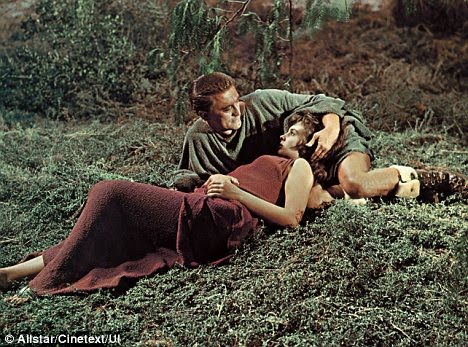
This equation running through the dialogue of Varinia and Spartacus - between love and knowledge, and desire and tenderness, and reverence and yearning for advancement, and freedom and a burning urgency to intermingle their beings - this is a ravishing demonstration of the higher purposes of our life. Beautiful :-)

FULL MOVIE IN PARTS

Surrey Leader - Cadman no replacement for her husband

Surrey Leader - Cadman no replacement for her husband

Wednesday, April 20, 2011

Tuesday, April 19, 2011

Justin better than his dad: Maggie Trudeau


Question for Justin Trudean, son of the former Prime Minister of Canada, Pierre Elliot Trudean.
"In what way are you better than your father?" he is asked.

"Well, I think I'm more of a people's person. My dad liked people, but sometimes in little doses."


Toronto Sun quote first quoted April 3, 2011

Shaking his hand tonight, Justin's eyes did all the talking, I was speechless as he stood before me, he has an enormous energy that leaps and transcends his fathers reputation, his is magnetic and charming as he walks through the crowd and makes every effort to speak to every supporter and shake their hand. Growing up in a very Liberal household, I grew up with Trudeau mania and my Papou's strong liberal opinion. I like Justin, I think he has what it takes to bring  grace and charm back into politics, with time and more experience under his belt, if he learns to work the crowd on the podium as he does one on one........he has the potential for making his father proud in a very big way. Following in his fathers footsteps???........TIME WILL TELL.

My Greek Spirit , April 19, 2011

http://archives.cbc.ca/society/family/clips/1620/ -  Justin's Moving Eulogy for his father.

"The word multiculturalism has become synonymous in the mind of many Quebecers as being something that is imposed by English Canada," said Liberal MP Justin Trudeau, whose father — former prime minister Pierre Elliott Trudeau — made multiculturalism official government policy in 1971.
Pierre Trudeau raised his children in relative privacy in Montreal. Justin recalled fond memories of his father in a 2008 interview, saying that of all the family outings he enjoyed camping with his father the most--because "that was where our father got to be just our father—a dad in the woods.”[1] Justin studied English literature (BA , McGill University) and Education (B.Ed, University of British Columbia), eventually becoming a social studies and French teacher in Sir Winston Churchill Secondary School in Vancouver, British Columbia. He is currently completing a Master of Arts in Geography at McGill University. At his father's funeral in 2000, Justin delivered a memorable eulogy.[2]
On May 28, 2005, Justin Trudeau married Sophie Grégoire, a former model and Quebec television host. They have two children: Xavier James Trudeau (born October 18, 2007)[3] and Ella-Grace Margaret Trudeau (born February 5, 2009).[4]
Grégoire also lends her support to helping families, children and mothers. She is deeply involved in working with The Shield of Athena, a non-profit organization for victims of family violence.[8]
http://shieldofathena.com/en/

Monday, April 18, 2011

Glykeria tribute to Kazantzidis

Greek Traditional Song from Thrace, by Nektaria Karantzi (Live)

Byzantine Music

From Wikipedia, the free encyclopaedia
Byzantine music (Greek: Βυζαντινή Μουσική) is the music of the Byzantine Empire composed to Greek texts as ceremonial, festival, or church music. Greek and foreign historians agree that the ecclesiastical tones and in general the whole system of Byzantine music is closely related to theancient Greek system. It remains the oldest genre of extant music, of which the manner of performance and (with increasing accuracy from the 5th century onwards) the names of the composers, and sometimes the particulars of each musical work's circumstances, are known.

Extent of Byzantine music culture vs. liturgical chant proper

The term Byzantine music is commonly associated with the medieval sacred chant of ChristianChurches following the Constantinopolitan Rite. The identification of "Byzantine music" with "Eastern Christian liturgical chant" is a misconception due to historical cultural reasons. Its main cause is the leading role of the Church as bearer of learning and official culture in the Eastern Roman Empire(Byzantium), a phenomenon that was not always that extreme but that was exacerbated towards the end of the empire's reign (14th century onwards) as great secular scholars migrated away from a declining Constantinople to rising western cities, bringing with them much of the learning that would spur the development of the European Renaissance. The shrinking of Greek-speaking official culture around a church nucleus was even more accentuated by political force when the official culture of the court changed after the capture of Constantinople by the Ottoman Empire on May 29, 1453.
wikipedia
More than 3,000 pages of Byzantine music in English written with this font package are available at:


Nektaria Karantzi -Greek Orthodox Christian Byzantine Music


Nektaria Karantzi (born 5 August 1978, in Greece) is a Byzantine and traditional singerfrom Greece.

Education

[edit]Legal studies

Nektaria Karantzi studied law at the Aristotle University of Thessaloniki, and also obtained a postgraduate degree in criminal law from the University of Athens.[1] She is currently a doctoral candidate in criminal law at the University of Athens.

[edit]Music

She holds a diploma in Byzantine music from the Byzantine School of Music, and has been taught by notable tutors, including Dimitris Verykios. She is currently in training, since 2003, for traditional singing by the renowned interpreter of traditional songs, Chronis Aidonidis. In addition, she has studied thepiano and Western musical theory, and has also had voice training under the tutelage of Thanos Petrakis and Dina Goudioti.[1

Musical career

Nektaria Karantzi teaches Byzantine music at the “Central Conservatoire” of Athens.[1] She has also begun collaborating with Chronis Aidonidis in concerts and recordings.
She has participated in a series of five tapes/CDs which include the chanting of Byzantine hymns, from the age of fourteen already accompanying the blessed Elder Porphyrios. She also collaborated with Chronis Aidonidis in the recording of two albums: When Paths Meet (a double CD) and He Was Grieved.
She is part of the development group of an internet musical community in Greece, www.musicheaven.gr and is a producer at a Greek radio station.[1]
Wikipedia

Christ has Risen - Xristos Anesti - Glykeria and choir / Chronis Aidonidis - Nektaria Karantzi - Greek Orthodox music

CHRONIS AIDONIDIS -NEKTARIA KARANTZI - Greek orthodox music


it is a hymn ortthodoxs say on good friday during easter in church..........we are supposed to be simulating what women sang to Jesus when He was dead....Greeks have the tradition to sing sad songs in funerals.....but that only happens in some small villages now...!

Friday, April 15, 2011

Vote Liberal Vote Shinder

The differences between liberals and conservatives run wide and deep, and a new study suggests they may even be reflected in the very structure of their brains.

In the study, led by Ryota Kanai of the University College London, people who identified themselves as liberals generally had a larger anterior cingulate cortex — a comma-shaped region near the front of the brain that is involved in decision-making. By contrast, those who identified as conservatives had larger amygdalas — almond-shaped structures that are linked with emotional learning and the processing of fear. (More on TIME.com: In Politics, It's Survival of the Fittest, Literally)

These structural differences, the authors suggest, support previous reports of differences in personality: liberals tend to be better at managing conflicting information, while conservatives are though to be better at recognizing threats, researchers said. "Previously, some psychological traits were known to be predictive of an individual's political orientation," said Kanai in a press release. "Our study now links such personality traits with specific brain structure."

For the study, Kanai and his colleagues asked 90 young adults to rank their political views on a five-point scale from very liberal to very conservative. Then, the volunteers underwent structural MRI scans, which revealed "substantial differences" in brain structure.

Read more: http://healthland.time.com/2011/04/08/liberal-vs-conservative-does-the-difference-lie-in-the-brain/#ixzz1Jf2aIw61

Shinder Purewal is running as a Liberal candidate
Shinder is an active community member and has worked with new immigrants on settlement issues.

He served as the director of Progressive Inter-Cultural Service Society in Surrey and International Peace Project in Ontario. He also worked as an advisor to the Employment Equity Directorate in British Columbia, specifically on the issue of foreign credentials for new immigrants. Currently, he works as a Volunteer Advisor with the community youth, and is also a motivational speaker.

Canada’s 41st federal general election will be held on Monday, May 2, 2011. The Elections Canada website (www.electionscanada.ca) outlines how and when Canadians can cast a ballot. All Canadian citizens who are at least 18 years old on election day are eligible to vote. People can vote on election day or on an advance voting day, on Friday, April 22, Saturday, April 23 or Monday, April 25. People can also vote by mail or in person at their local Elections Canada office by special ballot.

Tuesday, April 5, 2011

Mediterraneo - 1992 Film


Filmed in the Greek Island in the Aegean Sea. The Island is called 'Megistis. (in Ancient Greek) or 'Kastellorizo' (Modern Greek).

The story takes place during the WWII when the island was held by Italy.

Tamama


A Interview with Greek author George Andreadis regarding the book "TAMAMA" one of the thousands of Orphans of Pontos and the creation of the Movie waiting for the clouds, based on his book..

WAITING FOR THE CLOUDS begins while the census clerks arrive early one morning int
the small port town of Trebolu. The streets remain empty and silent. Not everyone can
afford to be counted. Questions about one's past can open up too many wounds.

Ayse lives with her older and ailing sister Selma. Ayse, who never married, has dedicated her life to Selma since she became a widow many years ago. Their years of co-habitation have
created an intense bond between the two sisters. Ayse must now face the harsh reality that she will soon be alone. The mystery of Ayse's tragic past will be divulged through the curious eyes of a charming eight-year-old boy, Mehmet, who shares Ayse's profound loss at the death of Selma.

Ayse's tragedy begins as the unfortunate outcome of historical events: World War I and the fall of the Ottoman Empire brought about new nationalist waves in Turkey, thus creating
great tensions and conflicts between Greeks and Turks in the Black Sea region.

Waiting For The Glouds makes reference to the human pain of a nearly-forgotten historic incident. In the winter of 1916, the Ottoman Army evacuated the villages west of the recently Russian-occupied Trabzon. In what can be considered to be no less than ethnic cleansing operations, the Greek residents of several villages were pushed out of their homes in an unorganized and paranoid deportation effort.

Ayse's real identity is that of Eleni, the daughter of one of the evacuated Greek families.
When she was 10 years old, Eleni was forced to suffer a seemingly endless march southward through ice and snow with her mother, younger brother and infant sister.
After cold and starvation killed her mother and sister, Eleni bravely pushed on to save
herself and "Niko," her five-year-old brother.

Near death themselves upon their arrival at the outskirts of a faraway village, Eleni and Niko are taken in by a Turkish family. The trauma of young Eleni's brutal experience subsides through the loving bond she establishes with the teenaged Selma.

For some 50 years, Ayse has kept silent about her true identity to protect her status as Selma's sister. Now that her beloved Selma has passed away, Ayse suffers for the forgiveness of her long lost brother Niko.

In Waiting For The Clouds, Ayse's return to Greece will show proof of how irrational
political cruelty can psychologically and mentally displace human lives. Ayse was led to believe that status in Turkey was that of a foreigner. Although born in Turkey, she has
regarded Greece as her native country but she realizes that this was never the case at all,as she now sets foot in Greece for the first time. Waiting For The Clouds raises questions about "who we are" and "where we belong," as it digs deeper into the intrinsic universal
human feelings of love, guilt, fear and sharing.

Monday, April 4, 2011

:-) We cant stop laughing lololol

Greek DJ mixes


Karsilamas - Smyrna Izmir - Georgia Mittaki

Karsilama 9/8 fusion of Romanes / Gypsy, Turkish, and Greek folkloric styles with American Tribal Style / ATS bellydance. The music is vintage 1930s from Istanbul.


From Wikipedia, the free encyclopaedia

Karsilamas is a Turkish folk dance spread all over Northwest Asia Minor and carried to Greece by Asia Minor refugees. The term "karsilamas" comes from the Turkish word "karsilama" meaning "face to face greeting"

The dance is still popular on Northwestern areas of Turkey, especially on wedding parties, festivals and so on, it also transformed itself into Zeybekikos dance in Greece. Name zeybekikos may be derived from another Asia Minor dance "zeybek" yet, the dance of zeybekikos as a form much more adopts Karsilama figures and creates mixed genre of dance in Modern Greece by having the Asia Minor figures from zeybek and karsilama.

Karsilamas is a couple dance that is still danced in what was the Ottoman Empire, from Persia to Serbia, and in the Macedonia and Thrace regions of Northern Greece.

Figures of the dance may vary from region to region but main theme is two people face each other, and music rythmically controls their next moves. Traditionally people dance without any figure on their minds, just figures they have seen from their elders.

The meter is 9/8, and the basic move is danced in four small steps with durations 2,2,2,3 respectively. The style and mood (bouncy, smooth, lively, etc.) vary depending on the region.

Rumeli Karşılaması, Trakya Karşılaması, Merzifon Karşılaması, Edirne Karşılaması, Gümülcine Karşılaması, Giresun Karşılaması, Taraklı Karşılaması, Bilecik Karşılaması, Old Karsilamas (Παληός Καρσιλαμάς), Pigi Karsilama(Πιγκί), Ayşe Karsilama (İskender boğazı)(Αϊσέ)(Η Αγάπη Είναι Καρφίτσα)(, Aptalikos Karsilamas (Απτάλικος),. Asia Minor Karsilamas (Melinos karsilamas

Smyrna, izmir


"Smyrna and its surroundings" The singer is Georgia Mittaki (Γεωργία Μυτάκη) - Composer: (Σταύρος Παντελίδης)

All pictures originate without exception from Smyrna. They reflect the multi-ethnical landscape, show importend buildings and sights of Smyrna before 1922. You also see the different quarters, parts and suburbs of the city, like "Karatas - Melantia", "Pagos - Kadifekale", "Göztepe - Enopi", "Karsiyaka - Kordelio", "Kokaryali", "Buca" and "Bornova - Bournobat".
The whole Greeks, Armenians and the most of Levantiner left the city 1922 and in the following years. Most Jews of Smyrna emigrated, after Israel was created.

To more information about the pictures and the cosmopolitical history of Smyrna please visit:
http://www.levantineheritage.com/index.htm

Arvanitaki singing a remake of " Argile mou giati Svinis "


http://mp3skull.com/mp3/karsilamas.html - listen here free - click play

Giwrgos Koros - Karsilamas

Powered by mp3skull.com